Why Does Time Have a Direction?
How do human beings, bound to time, recognise its direction? Reversible equations of motion lead us towards entropy, the initial conditions of the universe, memory and the passage of time.
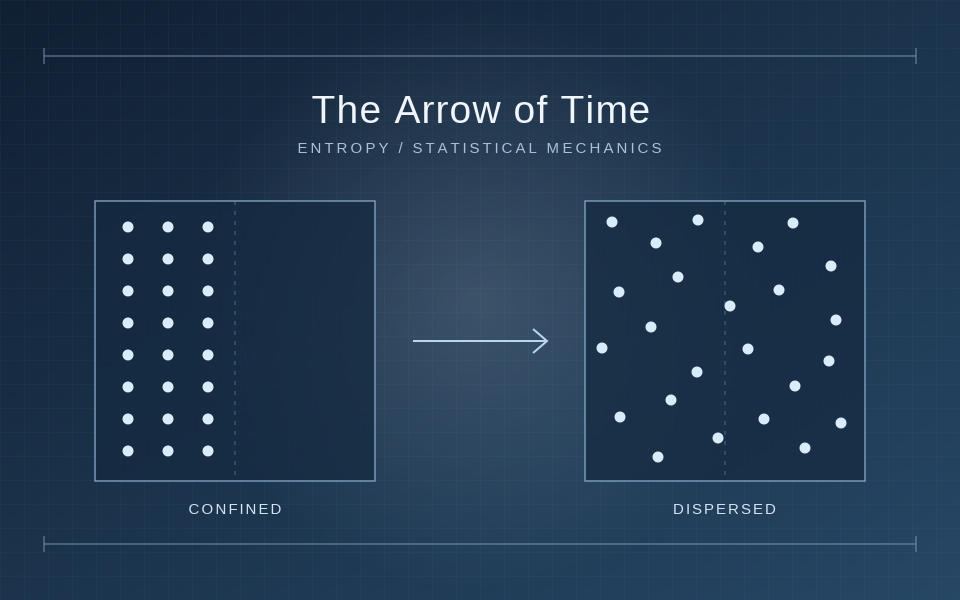
Image information ⓘ
Penumbra Journal · Original conceptual diagram (not a simulation)I wanted to be someone who could deal with time rather than be chased by it. On reflection, even the expression 'dealing with time' seems strange. Who among us can step outside time and look upon it? We are born within it, spend it trying to understand the world, and by the time we have arrived at that understanding, we have already become someone different.
Knowing how to read a clock is scarcely the same as understanding time. More curiously, there are occasions on which we can recognise its direction without a clock at all. Play backwards a film of a glass falling and breaking: its fragments gather together and an intact glass rises into the air. Nothing in the film tells us a unit of time, yet the scene feels wrong. What exactly are we seeing that leads us to that judgement?
Equations with time reversed
A simple equation of classical mechanics makes this confidence rather strange. Consider a particle under a force depending only on position: m d²x/dt² = F(x). Replace t with −t. The second derivative with respect to time does not change sign. If a motion is possible, the reverse motion with its velocities reversed does not violate this law either. In a film of an ideal frictionless pendulum, it is difficult to distinguish the forward direction by observing the motion alone.
A glass, too, is made of moving atoms. In ideal reversible mechanics, one could imagine reversing the process by reversing not only the fragments but also every relevant motion imparted to the floor and air. Yet the conditions required for that imagined event are vastly different from those required for a glass to break in ordinary life.
The number of possibilities
Suppose a box contains a gas, initially confined to its left half. Remove the partition and the molecules spread throughout the box. Now choose an idealised model in which each molecule is equally likely to be on either side, independently of the others. The probability that all N molecules occupy the left half is 2⁻ᴺ. For a single molecule it is one half; as the number of molecules grows, the probability falls rapidly.
In Boltzmann's expression for entropy, S = k_B ln Ω, Ω is the number of microstates compatible with a particular macrostate, or an appropriately defined phase-space volume. Behind the simple macroscopic description of a gas spread throughout a box lie countless arrangements of its molecules. They vastly outnumber those in which every molecule occupies the left half. Calling entropy merely disorder can obscure precisely this statistical meaning.
The second law of thermodynamics, according to which entropy does not decrease in spontaneous macroscopic processes in an isolated system, is related to this disparity. Small systems can fluctuate towards lower entropy. When considering why the glass does not spontaneously reassemble, there is no need to invent another law of classical mechanics forbidding reverse motion. Rather, the special microscopic configurations required for it are exceedingly rare.
The assumption of a special past
A troublesome question now arises. Why can we not apply the same statistical reasoning towards the past? If the laws of motion are reversible, reasoning from a low-entropy state towards a higher-entropy one in one temporal direction can also be applied in the other. This is the tension exposed by Loschmidt's reversibility paradox. The fact that the past was special does not follow from the equations of motion alone.
That is why the beginning of the universe becomes relevant. The Past Hypothesis assumes that the universe began in a macrostate of very low entropy. Combined with statistical assumptions and mechanics, it can explain the one-sided entropy increase we observe. The hot, relatively uniform early universe can be understood as a low-entropy state when gravity is taken into account, since gravitational evolution allows matter to gather into structures and black holes. Defining the entropy of the entire universe in general relativity, however, is far from simple.
Even if we accept the hypothesis, the question of why the universe began in such a state remains. Nor does cosmic expansion alone explain the arrow of time. Increasing spatial scale and changing entropy are distinct phenomena. Were the universe eventually to contract, we would have no grounds on that basis alone to conclude that shattered glasses would reassemble.
One further distinction matters. We considered a reversible equation of motion, but not every microscopic law possesses time-reversal symmetry. In 2012, the BaBar experiment directly observed time-reversal violation in transitions between particular states of neutral B mesons: the probabilities of transitions related by time reversal differed. This does not establish that T violation at the particle level explains the ordinary direction of heat flow or the breaking of a glass. The two asymmetries must be distinguished.
Memory and the present
Consider memory as a physical record. We can remember the glass before it broke, but cannot remember what we will break tomorrow. Taking a photograph or recalling an event involves information about that event being retained in a present physical state. In 2014, Mlodinow and Brun proposed an argument for the alignment of the psychological and thermodynamic arrows of time under particular assumptions about memory devices. Subsequent work has continued to investigate the connection between the asymmetry of records and the second law. This does not yet explain everything about the passage of time as felt in consciousness.
Is the claim that time has a direction even equivalent to the claim that time flows? Some philosophical accounts take the temporal ordering of events and physical asymmetries to be sufficient; others assign a distinct significance to the arrival of the present or to temporal passage. Between the answers physics provides and the experience of existing within time, there is still much to ask.
Perhaps what we can deal with is not time itself, but the changes that take place within it and the choices we make in response. Return to the glass. Nothing on its fragments is inscribed with the words past or future. We judge the direction of the film from what we know about the history of the glass and the world around it.
Is the direction we call the future, then, a property of time itself, or a property of the history of this world from which we cannot step outside?
References
- Stanford Encyclopedia of Philosophy — Thermodynamic Asymmetry in Time
- Stanford Encyclopedia of Philosophy — Philosophy of Statistical Mechanics
- Sean Carroll — From Eternity to Here: FAQ
- BaBar Collaboration (2012), Observation of Time-Reversal Violation in the B⁰ Meson System
- Mlodinow & Brun (2014), Relation between the psychological and thermodynamic arrows of time
- APS Physics — Why We Can’t Remember the Future
- Memory Systems, the Epistemic Arrow of Time, and the Second Law (2024)