Why Chess Openings Matter
When does a defeat begin? The opening reveals how two players with equal material come to possess very different possibilities.
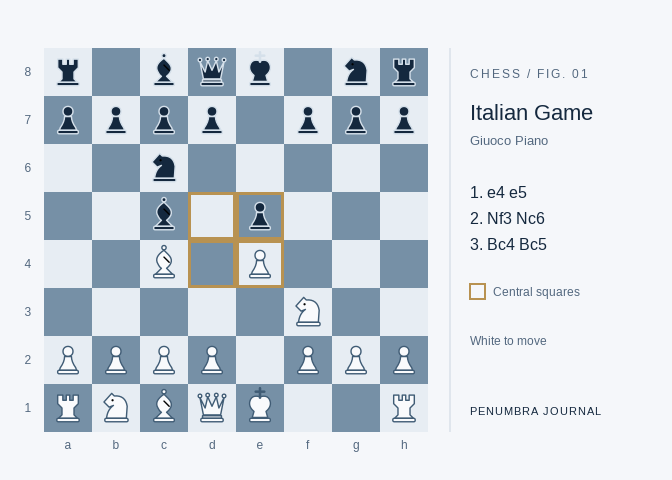
Image information ⓘ
Penumbra Journal · Original diagramI enjoy playing chess. Those who enjoy such games tend to develop a rather foolish attachment to winning. Yet there is something that puzzles me as I play. At what point does the balance of a game begin to tilt? Must one make an obvious mistake in order to lose?
It is easy to attribute defeat to the last piece we overlooked or the final tactic we missed. That may indeed have been the decisive mistake. But what was the position like before that move? If the opponent has several ways to attack and I have only a way to fend off one of them, might the problem have arisen earlier? I found one of the factors shaping the moves that follow in the opening.
Equal material, different possibilities
The beginning of a chess game is rather peculiar. Apart from White's right to move first, the two players have identical pieces arranged symmetrically. Within a few moves, however, one bishop is looking deep into the opposing position while another remains imprisoned behind its own pawns. Neither side has lost a piece yet.
To understand the opening, we must look beyond the number of pieces to what they can do. The four central squares, d4, d5, e4 and e5, help pieces reach either flank and restrict opposing movements. Consider an ordinary first move, 1.e4. It appears to advance a single pawn, yet it exerts influence over d5 and f5 and opens a path for the bishop on f1. The object is not to crowd the centre with pawns; knights and bishops can control it from a distance as well.
In that sense, development means more than moving a piece from its starting square. After 1.e4 e5 2.Nf3, White develops a knight whilst threatening the pawn on e5. Black's 2...Nc6 answers the threat and develops a knight in turn. A move can improve one's position while demanding a response or providing a necessary defence.
In chess, one can make only one move at a time. That is what makes the notion of tempo interesting. Bring out the queen too early and, if it must retreat whenever an opposing piece attacks it, the opponent may develop other pieces in the meantime. A concrete tactical gain can justify moving the same piece repeatedly. What matters is not the number of moves in itself, but how the positions of both players change whilst those moves are spent.
Being ready to attack does not mean that all preparations are complete. Consider where the king will be when central pawns are exchanged and files open. If several pieces are tied down defending the king, fewer are available for attack. Castling moves the king towards a flank and the rook nearer the centre, generally easing the problem. Yet depending on the flank pawn structure and opposing threats, the king may be safer in the centre. Castling, too, should serve a purpose.
The board after three moves
Look at the diagram of the Italian Game after 1.e4 e5 2.Nf3 Nc6 3.Bc4 Bc5. Neither side has lost material. Nevertheless, the bishops point towards f7 and f2 respectively, squares initially defended only by their kings. White has also cleared the path for kingside castling; Black still has to develop the knight on g8. Central influence, development and king safety are all present in those few moves.
But what if Black chooses Nf6 rather than Bc5 on the third move? White's e4-pawn is now threatened. To someone who remembers only the sequence, an exception has appeared. To someone who understands the purpose of the moves, there is a clear reason to examine the new threat. Even within the same Italian Game, the opponent has no obligation to make the same choices each time.
A beginner studying openings might take one they frequently play and try to explain what is gained and what is surrendered with each move. When reviewing a game, it is also worth asking why a move one wanted to play had already become unavailable, rather than attending only to the final mistake.
When does defeat begin?
A favourable opening does not guarantee victory. Returning to the first question, there may be no single point at which defeat begins in every game. Yet each move changes not only the position but also what can be done next. The opening is where that change begins.
What is worth remembering, ultimately, is not merely the sequence of moves that already exists, but the possibilities for moves that have yet to be played.