Where Will AI Put Its Heat in Space?
SpaceX's orbital data centre proposal raises a physical question about computing: how to reject heat in a vacuum, and where the costs of technology go.
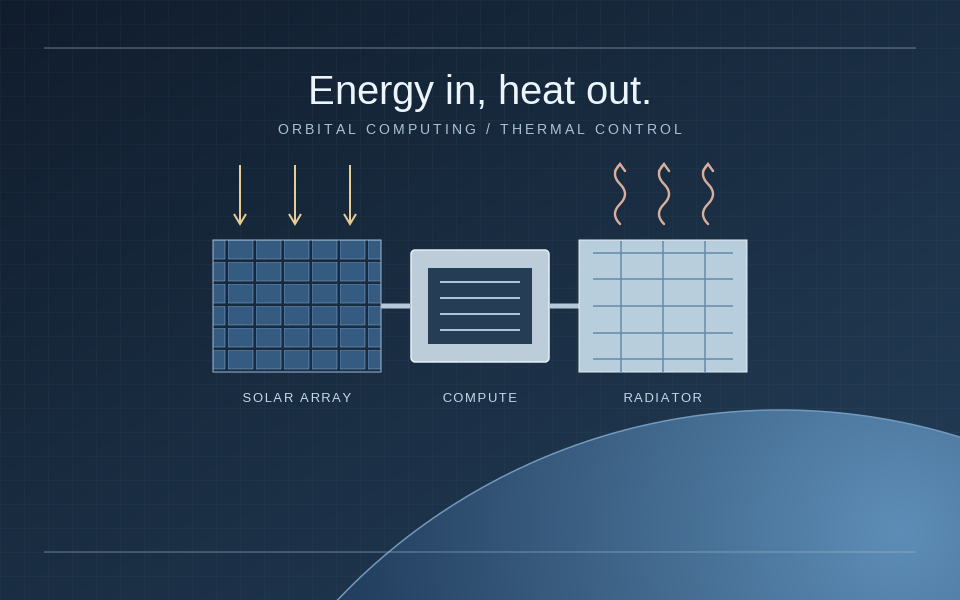
Image information ⓘ
Penumbra Journal · Original conceptual diagram (not an actual satellite design)Ask artificial intelligence a question and words appear on a screen. Whilst those words are being generated, electrical current flows somewhere and heat is produced. For those of us who encounter only the words, the latter process seldom feels real.
On 25 November, the US Federal Communications Commission conditionally authorised SpaceX's Starmind project to deploy up to one million orbital computing satellites. A million such satellites do not yet exist, nor does authorisation establish that a system of that scale can be operated. It is an authorised proposal. Nevertheless, the idea of taking data centres, which we have built on the ground, into space is a fascinating one.
Electricity demand forms part of its background. In its 2026 report, the International Energy Agency projected that global data centre electricity consumption would rise from 485 TWh in 2025 to around 950 TWh in 2030. Harnessing sunlight in orbit might reduce some dependence on terrestrial electricity grids and land. But answering the question of where to obtain power does not answer every question involved in keeping a computer running.
A cold vacuum
Space is cold. Would it not, then, be a good place to cool a computer? The thought seems natural, until one considers that for cooling, what is present in the surroundings matters just as much as their temperature.
A hot computer on a desk can transfer heat to the surrounding air. A fan moves that air and carries heat away. In the vacuum of space there is virtually no air to perform that function. A gas or liquid can circulate inside a spacecraft, but the heat must eventually be expelled. The principal means of continuously rejecting heat across a vacuum is electromagnetic radiation: thermal radiation.
By the Stefan–Boltzmann law, the power emitted by an isothermal grey-body radiator facing cold space can be written as follows under idealised conditions that neglect incoming radiation. Here is emissivity, is the Stefan–Boltzmann constant, is the emitting surface area and is absolute temperature.
Imagine a hypothetical device that must continuously reject 100 kW of waste heat. With an emissivity of 0.9 and a radiator temperature of 300 K, each square metre emits around 413 W. The required emitting area is roughly 242 square metres. At 400 K it falls to around 77 square metres. These are not Starmind design specifications; they are illustrative calculations of the relationship between temperature and area.
Why not make the radiator hotter, then? A higher temperature favours radiative heat rejection, but computing hardware has its own operating temperature limits, and heat must still be transported to the radiator. Depending on the design, a heat pump may consume additional power. In low Earth orbit, sunlight and radiation emitted or reflected by Earth must also be accounted for. Putting a hot object in cold space does not complete the thermal design.
Leaving Earth
None of these constraints proves orbital data centres impossible. Cooling on Earth also consumes energy and requires equipment. Only a comparison that includes the conditions for reliable solar power in orbit, launch and operating costs, radiator mass, communications and maintenance can begin to establish which arrangement is preferable.
Leaving Earth has implications beyond engineering, too. On 25 November the American Astronomical Society expressed concern about the Starmind authorisation. The effects of large numbers of satellites on observations of the night sky, and the management of collisions and orbital debris, are also matters of design and operation. The prospect of relieving pressure on terrestrial grids deserves consideration alongside the potential new burdens imposed on our shared orbital environment.
The appearance of words on a screen remains a light and silent affair. Imagine a world in which solar arrays and radiators are unfurled in space to produce those words, and that silence becomes rather peculiar. Accustomed as we are to asking how intelligent AI can become, perhaps we ought also to ask where it will put its heat.
References
- Reuters (25 November 2026) — US authorizes SpaceX to deploy 1 million satellites for data centers in space
- FCC (25 November 2026) — FCC Authorizes 1 Million Satellites for Data Centers in Space
- IEA (2026) — Key Questions on Energy and AI: Executive summary
- NASA — Small Spacecraft Technology State of the Art: 7.0 Thermal Control
- American Astronomical Society (25 November 2026) — AAS Leadership Available to Comment on FCC Approval of SpaceX's Orbital Data Center System